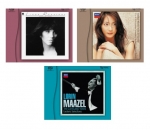
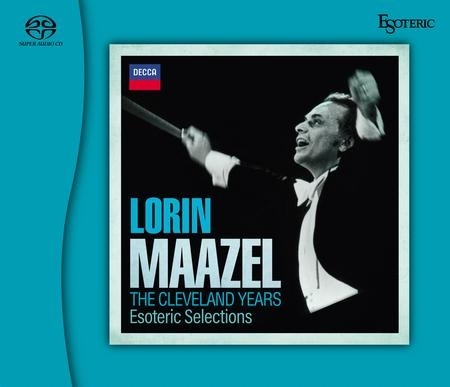
Lorin Maazel / Cleveland Years (CD/SACD Hybrid 3장) [Pre-order item - Shipping expected after December 14th]
■Release Date: December 12, 2026
■Catalog Number: ESSD-90330/32
■Specifications: CD/SACD Hybrid
■JAN: 4907034226429
■Label: DECCA
■Sound Source Provided by: Universal Music LLC
■Genre: Orchestral Music/Concertos
■DSD Mastering
■Super Audio CD Layer: 2-channel Stereo [No Multi-channel]
■Beautiful Deluxe Paper Digipak Packaging
This is a record of performances by the renowned Cleveland Orchestra with the genius conductor Lorin Maazel during his 40s, a period when he was at the height of his career and overflowing with talent. It contains famous performances and recordings from the peak of the analog era, when the Decca label was still developing its uniquely dynamic sound. The lineup mainly consists of works by Debussy and Ravel.
■ Assuming the position of principal conductor of the Cleveland Orchestra in his 40s, succeeding George Szell This
collection compiles works recorded on the Decca label during the last years of the analog era, when Lorin Maazel (1930-2014) served as music director of the Cleveland Orchestra during its peak as a conductor, a period when the Decca label was particularly outstanding in terms of sound quality.
The Cleveland Orchestra, founded in 1918 during World War I with the backing of local millionaire Adela Prentiss Hughes, gained fame after George Szell became its fourth principal conductor in 1946. A few years prior, Szell, unable to return to Europe due to the effects of World War II, began reforming the orchestra. Expanding the membership and building the finest ensemble, he succeeded in elevating the orchestra to a world-class level, not only in America, through his strict, perfectionist leadership. Szell passed away suddenly in 1970. Pierre Boulez, who had accompanied him on his visit to Japan, spent a period as music advisor, and in 1972, Lorin Maazel, in his 40s, succeeded Szell as music director.
■A true prodigy and genius! Maazel was a superstar conductor who also had a successful career as a violinist,
and was also known as a violin virtuoso. A multi-instrumentalist who served as conductor and performer at the New Year's Concert for many years, he was a maestro who was active for over half a century, from the 1950s until his death at the age of 84. Born in Paris, he soon returned to the United States with his parents, where he studied violin, piano, and conducting in Los Angeles and Pittsburgh. At the age of nine, he conducted at the New York World's Fair, gaining a reputation as a child prodigy. For several years afterward, he conducted orchestras in various then dedicated himself to the violin, making his recital debut at the age of 15. In 1948, he joined the Pittsburgh Symphony Orchestra as a violinist. A major turning point came during his studies in Rome from 1952. In December 1953, he gained recognition for stepping in as a substitute for a conductor who had suddenly fallen ill, and began his career as a conductor in earnest. He gained recognition for his work with orchestras and opera houses throughout Europe.
■His prolific youth and recordings from his Cleveland days that captivated not only music fans but also audiophiles
After the war, record companies, which were rapidly developing with the advent of LPs, could not overlook young talents achieving success in various places. In 1957, the year before stereo LPs became a reality, Maazel signed a recording contract with Deutsche Grammophon at the unusually young age of 27, and proceeded to record one after another, starting with "Romeo and Juliet" with the Berlin Philharmonic. Then
, in 1960, Maazel made a highly acclaimed debut at the Bayreuth Festival with "Lohengrin," becoming the youngest and first American conductor in its history. In 1962, following a US tour with the Orchestre National de Radio France, he made his debut at the Metropolitan Opera, conducted concerts with the Vienna Philharmonic and the Czech Philharmonic, and in the autumn, he accompanied the Berlin German Opera on its first tour of Japan, making his first visit to the country and creating a great sensation by conducting the Japanese premiere of the opera "Tristan und Isolde" from memory.
From 1963, Maazel signed with Decca and recorded complete sets of Tchaikovsky and Sibelius symphonies with the Vienna Philharmonic, further enhancing his fame with the rise of stereo. From 1965, he concurrently served as music director of the Berlin German Opera and the Berlin Radio Symphony Orchestra, and in 1972, he became music director of the Cleveland Orchestra.
■Two CDs containing previously unreleased Debussy and Ravel recordings
Maazel held the important position of music director of the Cleveland Orchestra, which his predecessor George Szell had led for approximately 25 years and developed into a world-class orchestra, until 1982. During that time, he made many recordings, and this release focuses on Decca works from that approximately 10-year period.
He recorded a vast repertoire spanning more than half a century, but among them, the Decca recordings from the 1960s onward, mainly with the Vienna Philharmonic and the Cleveland Orchestra, are particularly important. While his recordings of Prokofiev's ballet "Romeo and Juliet" and Gershwin's opera "Porgy and Bess," made shortly after joining the Cleveland Orchestra, also garnered attention, his recordings of French music by composers such as Bizet, Debussy, and Ravel are also noteworthy. His recordings of Ravel's operas "L'enfant et les sortilèges" and "L'heure espagnole" (Deutsche Grammophon) with the Orchestre National de France in the early 1960s were highly acclaimed, but his intensive recordings of French music began in the late 1970s during his time with the Cleveland Orchestra.
This album, "Cleveland Years," features two discs of Debussy and Ravel recordings from that series, which had never been released on CD in Japan before, and the third disc includes the Decca debut recording of Lynn Harrell, a virtuoso who transitioned from principal player of the Cleveland Orchestra to soloist, as well as three pieces from "Overture Masterpieces."
These performances by Maazel in his late 40s fully utilize the Cleveland Orchestra's refined ensemble and sound, and are masterful performances in which even the slightest nuances of tone and expression are expressed without excess or deficiency through precise tempo. And with this hybrid disc, I think many people will rediscover not only the charm of Maazel in his prime, but also the brilliance of these masterpieces from the peak of analog recording by Decca's renowned producers, James Marineson and Michael Woolcock.
■"Decca's sound" brings out the full charm of Maazel/Cleveland. Full of audio highlights!
From the perspective of sound quality, Decca's recordings of Maazel and the Cleveland Orchestra from this period can be said to be important examples demonstrating the synergistic effect between performance and recording.
For example, in the opening of the first movement of "La Mer," the way the rhythmic movement emerges as multiple instruments layer their sounds is vividly depicted, and the process of how the movements of each part develop and unfold in relation to one another is clearly visible on this disc. Such a performance that allows one to see through to such detail was rare at the time, and the appeal of visualizing the structure of the work down to the smallest detail is exceptional, and it will sound fresh even to ears that have repeatedly listened to many great performances and recordings. In "Play of the Waves," the movements of each section unfold in a more three-dimensional and complex way, but all the more so the intention of the recording to depict the details in meticulous detail is conveyed, and the movements of the inner voices and the instruments that handle the rhythm are clear, and it is immediately obvious how each part plays the melody and what kind of rhythm the low strings and percussion are keeping.
In the Nocturne, the subtle distinction in timbre is exquisite. I want to listen carefully to the richly nuanced harmonies created by the muted string instruments divided into multiple voice parts, and in the second movement, "Festival," the dynamics feel particularly great, brilliantly capturing the powerful propulsion created by the cooperation of the low strings and percussion, and the dynamic fluctuations of air as a large volume of air moves instantaneously. The strong penetrating power of the female chorus in the third movement should not be missed.
Disc 2. This complete recording of Ravel's "Daphnis et Chloé" is from the earliest period (1974), but listening to the performance, which perfectly balances parts and the whole, it is clear that Maazel had already mastered the Cleveland Orchestra at this time. The vividly colorful sonic feast of "Lyceion's Dance" and the realistic depiction of the scene in "Chloe's Plea" are nothing short of magnificent, with persuasive expressions that seem to visualize the air and emotions. The wide range of dynamics in "The Dance of All (Bacchanale)" has the power to deeply move the listener.
Beyond the expressiveness of the woodwind players, the outstanding technique of the horns and trumpets, and the richness and tone of the strings—there is a sound that only the Cleveland Orchestra of this period could produce, and the ability to truly appreciate their exceptional performance is also thanks to Decca's clear recording.
Disc 3. The magnificent scale and rich sound of Elgar's Cello Concerto are both important elements that Maazel seeks in orchestral works, and at the same time, it seems to be a characteristic of the sound that Decca is particular about. The conductor, musicians, and recording team were all aligned in their goals, and it was a collaborative effort to fine-tune the balance towards that goal! The brilliant brass section in the Overture to "Roman Carnival" and other highlights that only an orchestra boasting superior performance technique can deliver are accurately captured, which is a strength of Decca's recording team, which has accumulated a wealth of recording experience. I
will also briefly mention Decca's recording team that participated in the Cleveland Orchestra recording project. The producers are James Marineson and Michael Woolcock, and the balance and recording engineers include Colin Moorefoot and Gordon Parry. These individuals, disciples of the legendary Kenneth Wilkinson, a star of Decca, all played a central role in recording teams from the 1960s to the 1980s, and are highly experienced staff who have been involved in the production of a vast number of albums. Parry is famous for his work as an engineer on Solti's "The Ring of the Nibelung" session recordings alongside John Culshaw, and Marineson, after leaving Decca, became a renowned producer who worked on a huge number of recordings for multiple labels such as LSO Live. The expertise and wisdom of these individuals are evident throughout this collection of works.
■This is the first time that Decca's analog-era remasterings have been remastered into Super Audio CD hybrids using Esoteric's top-of-the-line equipment
. The masters have been newly remastered specifically for Super Audio CD. As with previous works, we carried out an uncompromising process from selecting the master to use to the final DSD mastering stage. In particular, for DSD mastering, we used "Esoteric Mastering." We employed ESOTERIC's top-of-the-line equipment, the Master Sound Discrete DAC and Master Sound Discrete Clock, which were meticulously tuned. Furthermore, by generously using MEXCEL cables, we were able to transfer the information contained in the original master to the disc with a rich and expansive sound.
Tracklist
Lorin Maazel / The Cleveland Years
[Disc 1]
Claude Debussy
Symphonic Poem "La Mer" (The Sea)
01 No. 1: From dawn to midday on the sea
02 No. 2: Play of the waves
03 No. 3: Dialogue of the wind and the sea
Ibéria (Images for orchestra)
07 No. 1: Streets and country roads
08 No. 2: Scents of the night
09 No. 3: Morning of the festival d'un jour de fête
[Disc 2]
Maurice Ravel
Daphnis et Chloé Ballet in three parts
Part 1
01 Introduction and religious dance
02 General dance
03 Dorcon's grotesque dance - Scene
04 Daphnis's light and graceful dance
05 Lycéion's dance - Scene (The Pirates)
06 The slow and mysterious dance of the Nymphs
Part 2
07 Intermezzo Introduction
08 Dance of War (Danse guerrière)
09 Chloe's Pleading Dance (Scène – Danse suppliante de Chloé)
Part 3
10 Dawn (Lever du jour – Scène)
11 Pantomime (The Tale of Pan and Syrinx by Daphnis and Chloe)
12 Dance of All (Bacchanale) (Danse générale (Bacchanale))
Claude Debussy
13 Ballet "Jeux" (poème dansé)
[Disc 3]
Edward Elgar
Cello Concerto in E minor, Op. 85
01 Movement 1: Adagio - Moderato
02 Movement 2: Lento - Allegro molto
03 Movement 3: Adagio
04 Movement 4: Allegro
Pyotr Ilyich Tchaikovsky
05 Variations on a Rococo Theme, Op. 33 moderato assai quasi andante
Theme: Moderato semplice
Variation 1: Tempo del tema
Variation 2: Tempo del tema
Variation 3: Andante sostenuto Variation 4:
Andante grazioso Variation
5: Allegro moderato
Variation 6: Andante
Variation 7 and Coda: Allegro vivo
Mikhail Glinka
11 Overture to the opera Ruslan and Lyudmila
Ludwig van Beethoven
12 Overture to the ballet music The Creatures of Prometheus, Op. 43
Hector Berlioz
13 Overture "Le Carnaval romain", Op. 9
[Performance]
Conducted by Lorin Maazel
The Cleveland Orchestra
[Disc 1] 06 Ladies of The Cleveland Orchestra Chorus
[Disc 2] 01,07,08,10,12 The Cleveland Orchestra Chorus [Disc
3] 01-05 Lynn Harrell (Cello)
[Recording]
Masonic Auditorium, Cleveland
[Disc 1]
01–03 October 4, 1977
04–09 May 5–10, 1978
[Disc 2]
01–12 July 15–17, 1974
(13 tracks) May 5–10, 1978
[Disc 3]
(1–10 tracks) October 19–23, 1979 (11–13 tracks
) August 26, 1975
[Original Recording]
[Producers] James Marineson, Michael Woolcock
[Balance Engineers] Colin Moorefoot, Gordon Parry
[Recording Engineers] Michael Miles, Andrew Pinder, Colin Moorefoot, Stanley Goodall, Martin Atkinson, Gordon Parry


)





 !


